
Insights
If you’re reading this, there’s a good chance that at least part of your business is currently powered by a file ending in .xlsx. That file is likely on a shared drive so that many people within your company can access it. You probably have more than one file, each containing various important information. You likely know the name of the file that holds the information you want, or maybe you open multiple files until you find the one you need. Most likely, you started using Excel when your business was formed, and it’s served you well for years, or even decades. But you’ve recently faced a painful realization: your business has reached the point of outgrowing Excel entirely.
The good news: you aren’t alone. As of 2026, over 200,000 verified companies, from local startups to giants like Amazon and Walmart, still rely on Microsoft Excel for critical operations. It is the “Swiss Army Knife” of the corporate world. But there is a tipping point where outgrowing Excel shifts from a minor inconvenience to a serious structural liability.
For a growing business, relying on Excel to manage core workflows is like building a skyscraper on a plywood foundation. It works for a while, but eventually, the cracks start to show. Here is why outgrowing Excel is a natural part of business growth, and why custom software is the upgrade you deserve to reach the next level.
The “Excel Paradox”: UI and Database in One
To understand why Excel is so popular and so dangerous, you must understand what it actually is. In software terms, Excel is a hybrid database and user interface (UI) welded together.
- The Database Side: It stores rows and columns of data, performs calculations, and holds “records.”
- The UI Side: It is the screen you see, the buttons you click, and the cells where you type. The UI enables modification of the data.
These two things are strictly separated in a professional software application. In Excel, they are the same thing. This creates a “What You See Is What You Get” environment that is easy to use but impossible to control.
The Illusion of Control
Because the “user interface” is just a grid of cells, anyone with access to the file can accidentally delete a formula, change a price, or overwrite a historical record with a single keystroke.
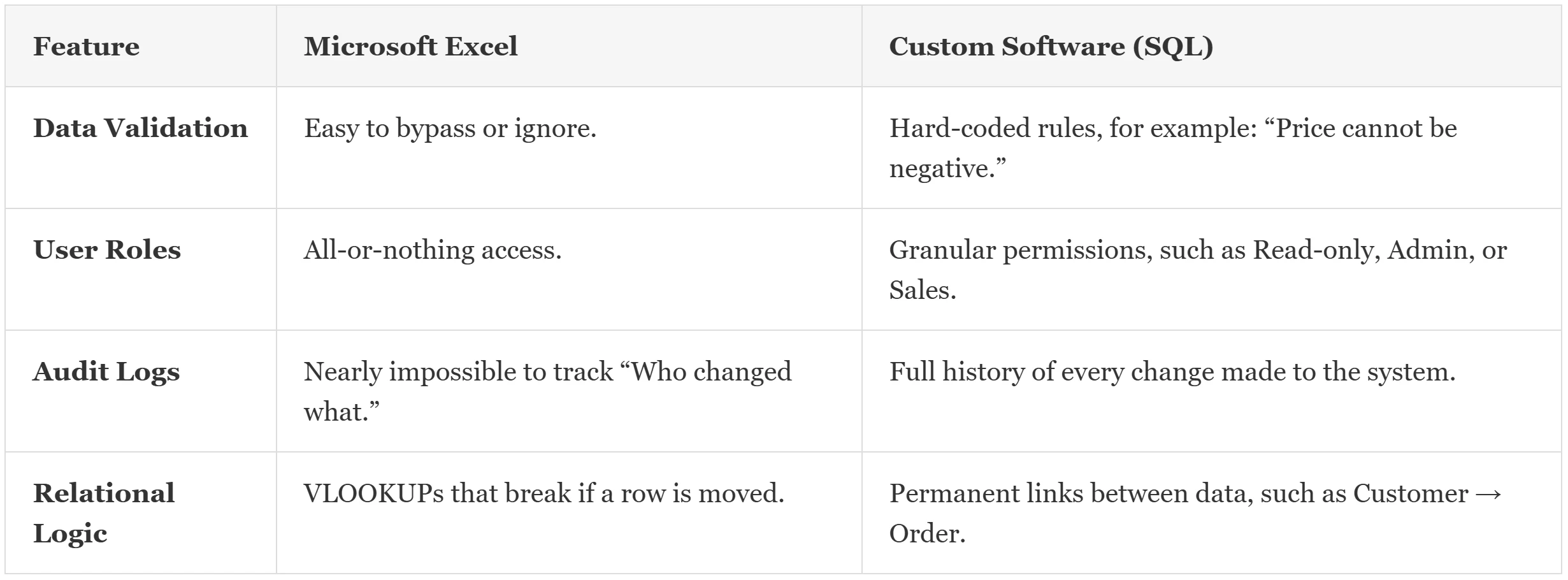
The biggest risk in an Excel-based business is the lack of data integrity. Excel offers almost no control over how users modify data.
In Excel, “garbage in” leads to “garbage out.” Without a well-engineered UI to act as a gatekeeper, your data is only as good as the most tired employee’s last entry.
The Multi-User Meltdown
Excel was never designed for a collaborative, high-velocity environment. When multiple users need to access and modify the same data simultaneously, the “Spreadsheet Struggle” begins:
The Solution: The Custom Software Advantage
Moving to a custom-developed application with a SQL database and a bespoke UI is a transformational opportunity for your business that has outgrown Excel.
By moving your data to a SQL database, you upgrade from “files” to “systems.” SQL is designed to handle millions of rows and hundreds of simultaneous users without breaking a sweat. It ensures that when User A updates a price, User B sees it instantly.
Custom software provides a well-engineered UI that guides the user. Instead of staring at 50 empty columns, your team uses a clean interface intentionally designed for their specific workflow.
- Forms ensure data is entered correctly.
- Buttons trigger complex workflows (like sending an invoice) automatically.
- Dashboards provide real-time insights that don’t require manual “refreshing.”
Custom software grows with you. Want to connect your sales data to your shipping provider? Or automatically email a customer when their order status changes? With a custom application, these integrations are native. In Excel, they require fragile “hacks” and manual exports.
When you develop software specifically for your business, it aligns with your workflow. You don’t have to change the way you work to match the software. The software can help make your workflow more efficient and automate tasks that might otherwise be manual in Excel.
Final Thoughts
Excel is a brilliant tool for ad-hoc analysis and quick prototyping. It works well for businesses just getting started, or for small, contained use-cases. But it is a poor engine to manage a growing business and is easy to outgrow. By investing in custom software, you are building security, scalability, and sanity.
Stop managing files and start managing your business. It’s time to trade the grid for a real solution.
Contributors


Recommended for You
Check out related insights from the team





Get empowered, subscribe today
Receive industry insights, tips, and advice from Saritasa.


