
Legacy Software Modernization Trends in 2026
Legacy software modernization is becoming an increasingly important priority for organizations trying to improve security, integrate modern technology, and support long-term growth. But according to Saritasa’s 2026 survey of more than 500 IT professionals, 68% of companies still rely on at least one legacy system, up from 62% in 2025.
The challenge isn’t simply that legacy software is old. It’s that aging systems increasingly compete for the same IT resources needed to modernize them. Internal teams are taking on more responsibility for maintaining legacy platforms, while security concerns, maintenance costs, integration challenges, and fear of disruption continue to delay modernization.
So, what is driving legacy software modernization in 2026, and what’s preventing organizations from moving forward? Our latest survey provides some answers.
Download the full report below.
What is Legacy Software Modernization?
Legacy software modernization is the process of updating, rebuilding, integrating, or replacing outdated software systems. Often, aging software is replaced to improve security, scalability, performance, or integrate with modern technologies.
Legacy software modernization can take many forms, from something as comprehensive as a full system rebuild to refactoring an outdated system or bridging gaps with microservices.
Why Legacy Software Modernization Matters in 2026
Legacy modernization supports business growth and creates a competitive advantage.
Modernized systems can help organizations:
- Improve security and compliance
- Reduce maintenance and technical debt
- Integrate with modern business applications
- Support cloud adoption
- Improve scalability and performance
- Make data more accessible
- Enable AI, automation, and advanced analytics
- Reduce dependence on aging infrastructure and specialized legacy knowledge
Summary of Key Findings
- 68% of companies still rely on legacy systems (up from 62% in 2025)
- 77% of companies rely on internal resources to maintain aging software (up from 68% in 2025)
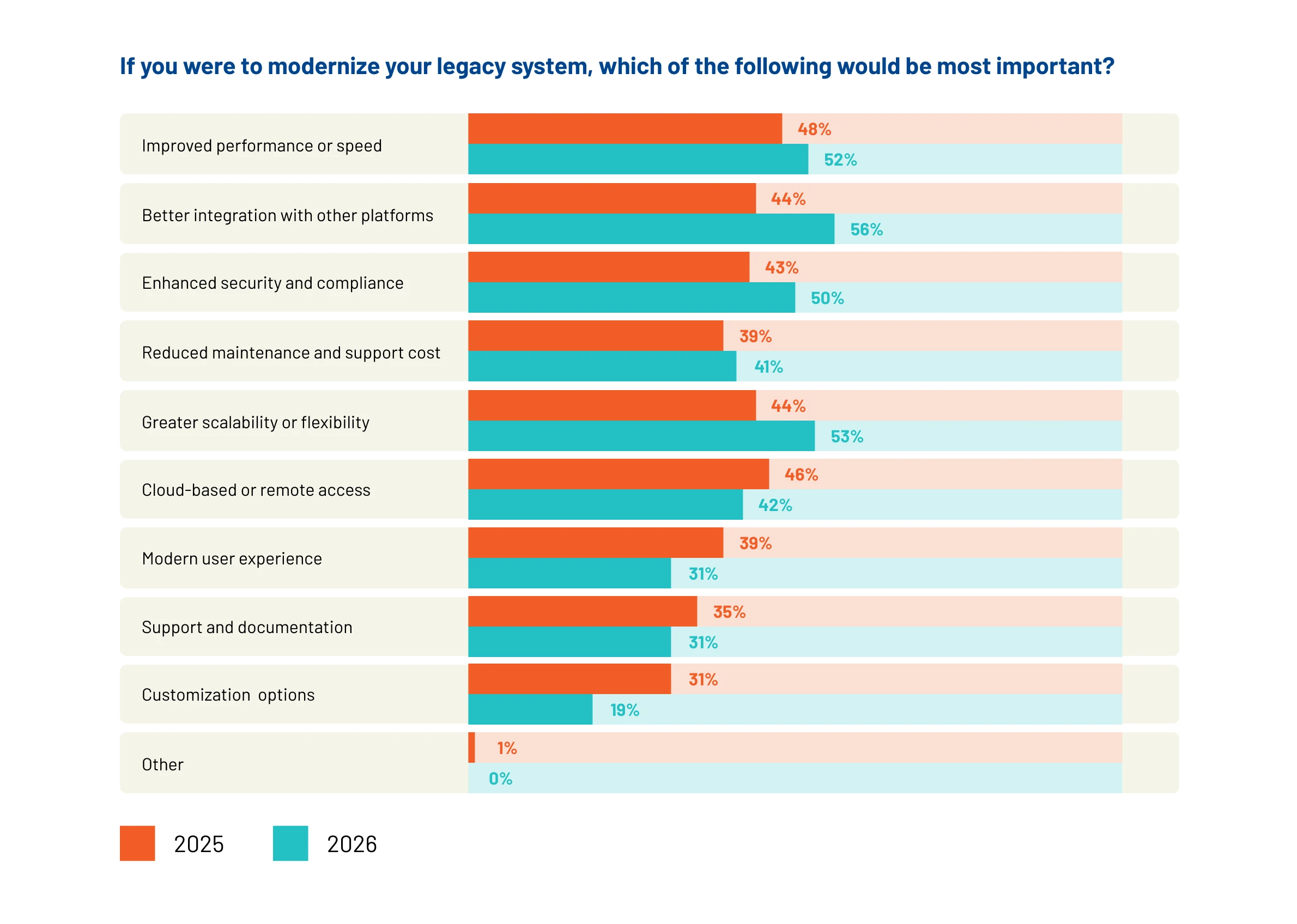
- 56% of IT leaders prioritize integration in modernization projects (up from 44% in 2025)
- 54% say they haven’t upgraded because “the current system still works”
- 54% say security vulnerabilities are their biggest concern (up from 43% in 2025)
The Shift in Legacy Ownership: How Legacy Systems Are Maintained in 2026
When asked who maintains these legacy systems,
- 77% rely on internal IT teams (up from 62% in 2025)
- 12% use dedicated legacy specialists (down from 20% in 2025)
- 8% rely on external vendors (up 1% from 2025)
- 3% have no dedicated support (down from 5% in 2025)
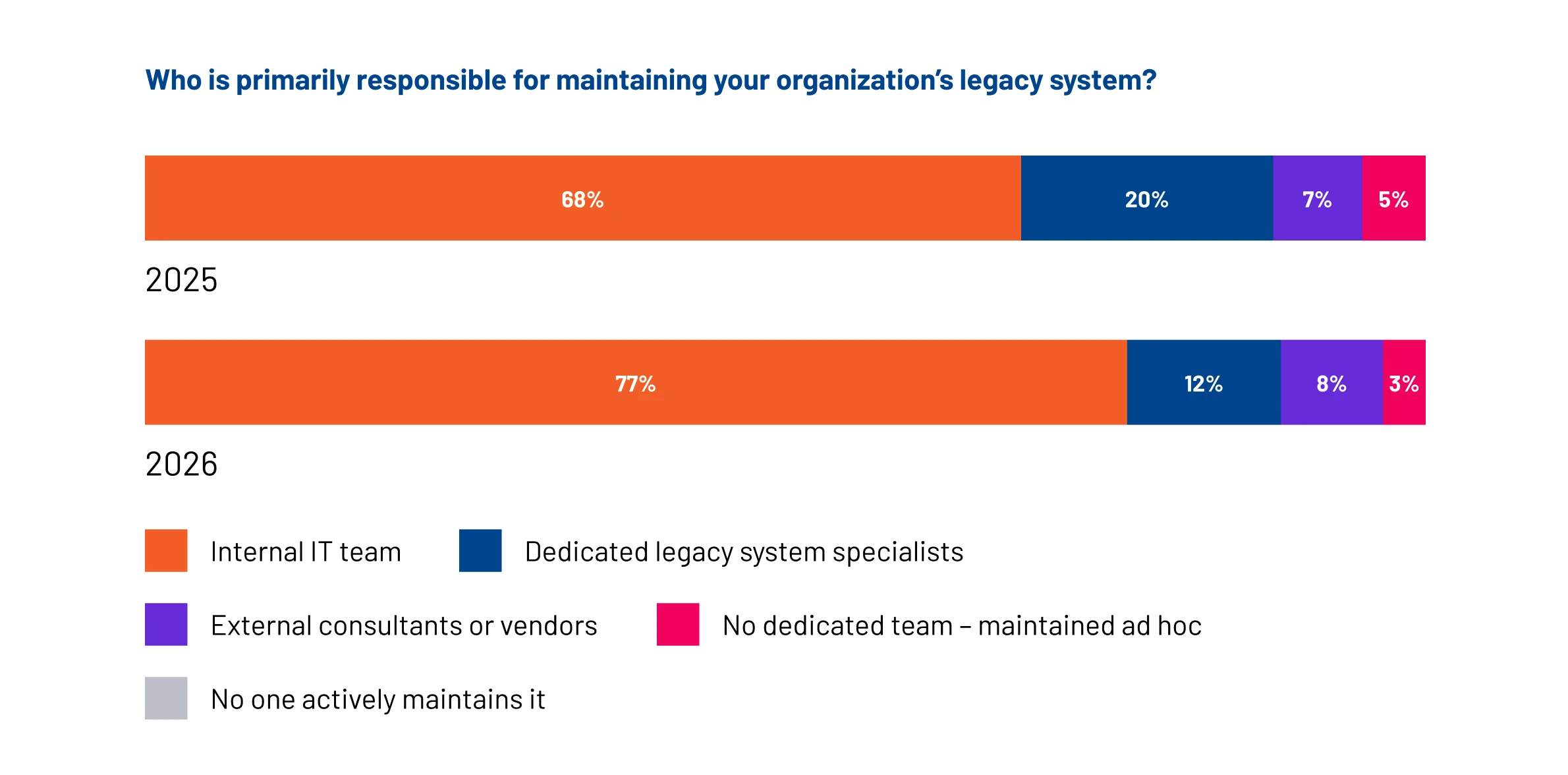
According to Saritasa’s 2026 survey, that burden is increasingly falling on internal IT teams: 77% of organizations now rely on their internal IT departments to maintain legacy software.
For already stretched IT departments, maintaining aging systems can compete directly with modernization initiatives, cybersecurity efforts, and other strategic technology priorities.
Top Legacy Software Challenges in 2026
What are the biggest challenges of legacy software in 2026? According to Saritasa’s survey, security vulnerabilities, maintenance costs, limited scalability, and incompatibility with modern tools are among the most commonly reported problems.
Between 2025 and 2026, nearly every major operational challenge associated with legacy systems escalated significantly. Far from saving money, keeping legacy software running without modernization compounds technical debt.
Four critical pain points have now crossed the 50% threshold, hitting critical mass across enterprise and mid-market organizations:
- Security Vulnerabilities (54%, +11 pts YoY): Unpatched frameworks represent an expanding attack surface, leaving organizations exposed to costly breaches and compliance penalties.
- High Maintenance & Support Costs (52%, +13 pts YoY): Escalating maintenance expenses saw the largest single jump in our survey, surging from fourth place to the second-highest overall challenge.
- Limited Scalability (50%, +10 pts YoY): Rigid, aging architectures prevent companies from expanding workloads, entering new markets, or adapting to operational shifts.
- Incompatibility with Modern Tools (50%, +9 pts YoY): Legacy platforms lack modern API structures, creating severe integration bottlenecks for cloud adoption and modern AI implementation.
Keeping fragile software running comes at a steep price: platforms grow increasingly expensive, security-exposed, and isolated from technological advances.
Why Organizations Delay Legacy Software Modernization
In 2025, a passive “if it isn’t broken, don’t fix it” mindset was the primary obstacle holding modernization projects back. By 2026, concerns about operational disruption and data migration have become increasingly prominent barriers to modernization.
While inertia (“the system still works” at 54%) and budget limitations (48%) remain top obstacles, four categories saw dramatic year-over-year spikes:
- Risk of Disrupting Current Operations (47%, +9 pts YoY): Technical teams fear that touching core architecture will cause unexpected downtime or break critical workflows.
- Concerns About Data Migration (43%, +8 pts YoY): Moving decades of unstructured or custom schema data to modern databases represents a massive risk point.
- Other Priorities Taking Precedence (32%, +9 pts YoY): IT teams are constantly pulled away to handle immediate business needs, pushing long-term upgrades down the backlog.
- Lack of Internal Resources or Bandwidth (28%, +6 pts YoY): Overstretched IT staff simply do not have the capacity to manage a major migration alongside their daily activities.
Together, these findings suggest that organizations aren’t necessarily unaware of the need to modernize. Instead, many are struggling with how to modernize without disrupting the systems their businesses depend on.
Top Priorities for Legacy Software Modernization
What do organizations want to achieve through legacy software modernization? In 2026, the top priorities are better integration, greater scalability, improved performance, and enhanced security and compliance.
The top modernization priorities for 2026 reflect a clear focus on core infrastructure over quality-of-life improvements:
- Better Integration with Other Tools or Platforms (56%, +12 pts YoY): Integration surged to the number one spot with the largest gain in our survey, proving that connecting legacy backends to modern platforms and AI tools is now the primary objective.
- Greater Scalability or Flexibility (53%, +9 pts YoY): Organizations need foundational architectures that can grow alongside business demand without requiring constant refactoring.
- Improved Performance or Speed (52%, +4 pts YoY): Speed remains a baseline requirement for maintaining daily operational efficiency.
- Enhanced Security and Compliance (50%, +8 pts YoY): Half of all IT leaders prioritize security upgrades to protect aging platforms from escalating cyber threats.
What These Trends Tell Us
The 2026 data points to an important shift: organizations aren’t simply asking whether legacy software should be modernized. They’re increasingly focused on how to connect, scale, secure, and extend the systems they already have.
Integration’s rise to the top modernization priority is particularly notable. Businesses increasingly depend on interconnected technology ecosystems, and legacy systems can become bottlenecks when they cannot communicate easily with modern applications, cloud platforms, analytics tools, or AI systems.
At the same time, rising concerns about security and maintenance suggest that the cost of keeping legacy software operational is becoming harder to ignore.
The takeaway is that organizations need a plan for what comes next. For some, that may mean refactoring or rearchitecting an existing application. For others, it may mean replacing the system entirely or taking a phased approach to modernization.
The earlier organizations understand their options, the more opportunity they have to modernize on their own terms, rather than waiting until an aging system forces the decision.
As Builders of Better, Saritasa helps empower businesses with modern technologies. By providing dedicated technical expertise, we help you modernize brittle systems safely.
Download the full 2026 State of Legacy Software Modernization Report or reach out to Saritasa to schedule a consultation on your legacy modernization strategy.
Contributors


Recommended for You
Check out related insights from the team




Get empowered, subscribe today
Receive industry insights, tips, and advice from Saritasa.


