
Insights
In a world where every business is looking for an advantage, how do you stand out? Many leaders assume they should use the same technology as everyone else. This means they settle for software that’s good enough but never truly great. The most successful companies, however, are building their own rules by leveraging technology that’s crafted for their specific goals.
This is where custom software development comes in. But what is custom software development? Instead of a product you buy off a shelf, it’s a tool you design and build exclusively for your business. It’s a strategic investment that can streamline operations, give you a competitive edge, and set your company on a path to sustained growth.
In this article, we’ll demystify what custom software development is and show you why it’s a powerful move for forward-thinking leaders who are ready to build a better business.
What is Custom Software Development?
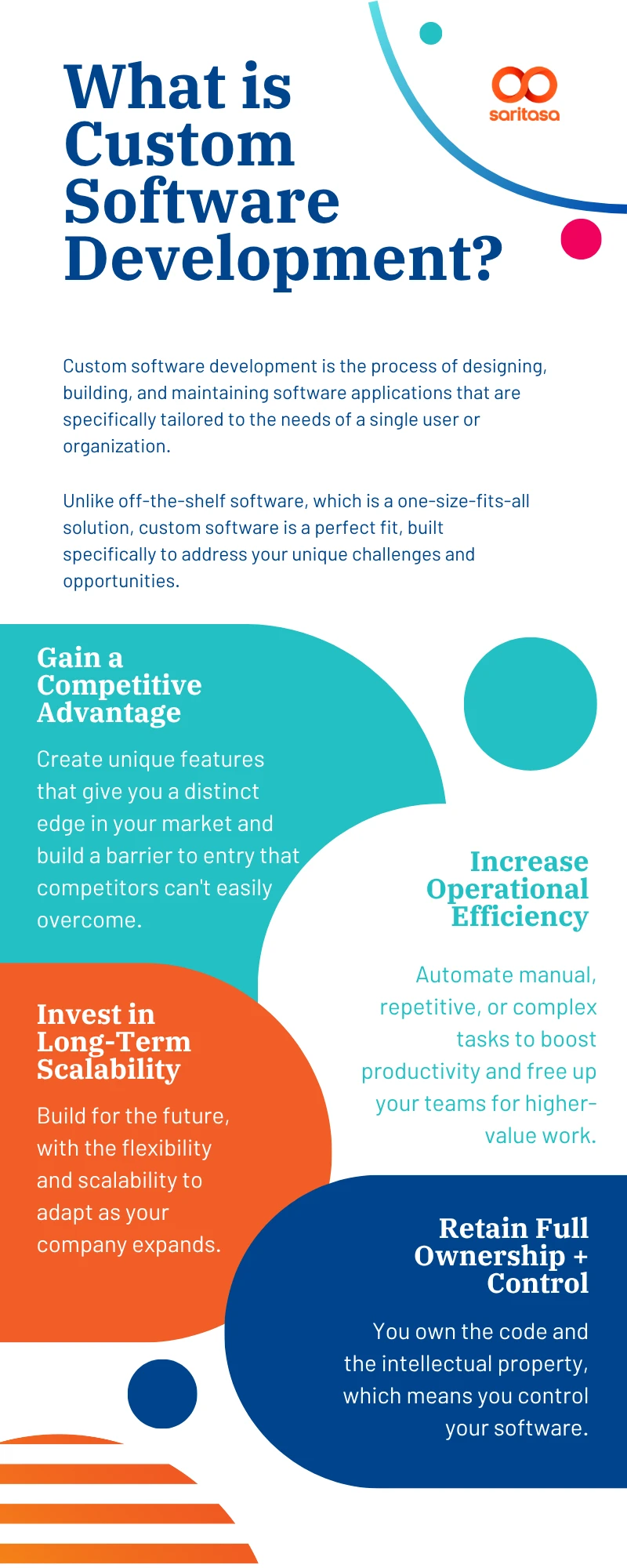
At its core, custom software development is the process of designing, building, and maintaining software applications that are specifically tailored to the needs of a single user or organization. This software development definition is key to understanding its value. Unlike off-the-shelf software, which is a one-size-fits-all solution, custom software is a perfect fit, built specifically to address your unique challenges and opportunities.
Think of it this way: off-the-shelf software is like renting a modular office space. It’s functional and sets up quickly, but limits you to a pre-set layout and design. A custom-developed application, on the other hand, is like hiring an architect to draw up an architectural blueprint. It’s a deliberate process of planning and design, ensuring every room and hallway is placed precisely. It creates a workspace that is uniquely fitted to your brand and optimized for maximum efficiency.
This tailored approach lets the software integrate seamlessly with your existing systems, automate your most complex workflows, and solve specific business problems that off-the-shelf products simply can’t. If you’re looking for examples of software that truly align with a business’s specific needs, custom solutions are the answer.
What are the Different Types of Custom Software Development?
When we talk about software development, we’re referring to a broad field with many specializations. The work of a software developer can be very different depending on the part of the system they’re building. Understanding the types of software development is crucial for any business leader. Here are a few of the most common specializations and what the different types of software developers focus on:
- Front-end Development: This is the part of a website or application that users interact with directly. Front-end developers are the builders behind the user interface (UI) and user experience (UX). They make sure the software looks great and is easy to use.
- Back-end Development: This work happens behind the scenes. Back-end developers create the logic that powers a software application, managing databases, servers, and APIs. Their work is the engine that makes the whole system run smoothly.
- Mobile Software Development: As the name suggests, this is the process of creating applications for mobile devices, like smartphones and tablets.
- 3D Software Development: These developers build immersive experiences using technologies like augmented reality (AR) and virtual reality (VR), creating new ways for users to interact with digital content.
- DevOps Engineer: A blend of software development and IT operations. DevOps engineers work to streamline the development process and ensure a fast, reliable, and continuous delivery of software.
- Database Development: These specialists design, implement, and maintain the complex databases that store and organize a company’s critical information.
- Systems Engineer: This role is focused on the architecture of a system, making sure all the components work together efficiently and effectively.
For those interested in the tools of the trade, programming software examples include languages like Python, JavaScript, and C++. All of which are used on a software development platform to build applications. But we don’t get deep into specific programming languages in this article.
Examples of the Benefits of Custom Software Development
While the initial investment in a custom solution may be higher, the custom software development examples we see in the market show that the benefits are substantial. For business leaders, it’s not just about having a unique application. It’s about the tangible value and competitive edge that it provides.
Strong Competitive Advantage
When you build a custom solution, you own the intellectual property. This allows you to create unique features that give you a distinct edge in your market. At the same time, you are building a barrier to entry that competitors can’t easily overcome. For example, Meridian Rapid Defense Group, a provider of mobile vehicle barriers, gained a powerful competitive advantage by building a custom software platform to automate the complex planning process for safety mitigation. This tool not only simplifies their internal operations but also functions as a visual sales tool. This proprietary software creates a better experience for their customers and gives the company a stronger position in the market.
Increased Operational Efficiency
Custom software mirrors your existing workflows; it doesn’t force you into a pre-defined mold. By automating manual, repetitive, or complex tasks, a custom application can boost productivity and free up your teams to focus on higher-value work. For instance, Allstar Elevator Inspection relied on a MS-Dynamics and Google Sheets setup that worked… with multiple workarounds, manual steps, and overall inefficiencies. The company invested in a custom software solution to move the entire workflow to a digital platform. This new system automated inspection reports and significantly improved operational efficiency.
Long-Term Scalability
Generic solutions can’t always grow with your business. Custom software is built for the future. It scales and adapts as your company expands, preventing costly and disruptive replacements down the line. A great example of this is LECS, an electrical contracting company that was spending a small fortune every year in SaaS licenses. Rather than paying for off-the-shelf software in perpetuity, LECS decided to build a bespoke system to handle their reporting, billing, and bonus workflows. This software allowed the company to move away from costly SaaS products and to a more flexible, scalable long-term solution.
Full Ownership & Control
With custom software, you are in complete control. You own the code and the intellectual property. This means you can change it, integrate it with any system you want, and align the solution perfectly with your business goals. The US Gymnastics Development Center, for example, built a custom software solution to manage its operations, which included complex pricing models that were difficult for other software to replicate. A custom web-based gym management system gave them full ownership and control to handle payments exactly how they wanted. It also transformed payment processing from a task that previously took days into one handled in under an hour.
Conclusion: Builders of Better
Custom software development is more than just code; it’s a strategic partnership and an investment in your company’s future. For business leaders looking to overcome limitations, gain a competitive edge, and unlock new levels of efficiency, a custom solution is the path to achieving those goals.
If you’re ready to stop fitting your business into a generic box, let’s talk. We’re Builders of Better, which means we’re ready to help you build something that’s truly your own.
Contributors


Recommended for You
Check out related insights from the team



Get empowered, subscribe today
Receive industry insights, tips, and advice from Saritasa.


